How to Train Bougainvillea on a Trellis for More Blooms
A bougainvillea on a trellis has gone wild into a single towering braid shooting skyward, with just a few sparse blooms at the very top and a completely bare structure below? After watching this for several years, Lanyao has found that most of the time it really isn't a variety problem—it's a tying problem. The branches have been left to grow straight up the whole time, so apical dominance keeps snowballing. Today, we'll cover how to train bougainvillea on a trellis for more blooms and how to combine that with flower pushing, all in one go.

First, remember this formula: horizontal branch training breaks apical dominance + 8 hours of direct sunlight per day + low-nitrogen, high-phosphorus, high-potassium fertilizer = a trellis bursting with flowers.
Table of Contents
Why branches that grow horizontally bloom more readily
The terminal bud of every upright branch is a scene-stealer: auxin concentrates at the tip, suppressing the lateral buds in the middle and lower sections, and nutrients are sent to the tip first. The more vertical the branch, the stronger the suppression, the fewer chances the lateral buds get, and in the end you get a bare stick with just a few flowers at the top.
Tie the branch flat against the trellis, and the tip is no longer the highest point. Once the suppression is lifted, nutrients are redistributed evenly, and every bud along the branch comes alive. Research also confirms it: bending branches promotes axillary bud formation and significantly increases the number of flower buds. Bougainvillea flowers on the current year's new growth, and that new growth is exactly what sprouts from these lateral buds. More side branches mean more blooming points. Turning one branch into a wall of flowers depends on this one step—this is the core of training bougainvillea on a trellis for more blooms.
However, branch training is only one part of the process. To turn these new lateral shoots into abundant flowers, you also need to provide sufficient sunlight, control watering, use the right fertilizer, prune at the proper time, and choose a well-draining container and potting mix. Learn how to get bougainvillea to bloom by combining horizontal training with these essential care practices.
Here's a pitfall to mention up front: bougainvillea has no tendrils and doesn't twine. It can only hook onto things with its thorns and lean on support. If you don't tie it, it will just keep shooting straight up.
| Branch posture | Apical dominance | Lateral bud sprouting | Blooming performance |
|---|---|---|---|
| Upright | Strongest | Barely any sprouting | Only a few flowers at the top |
| Trained at a 45° angle | Reduced | Partial sprouting | Scattered blooms in the middle |
| Tied horizontally at 90° | Broken | Abundant sprouting | Multiple blooms along the entire branch |
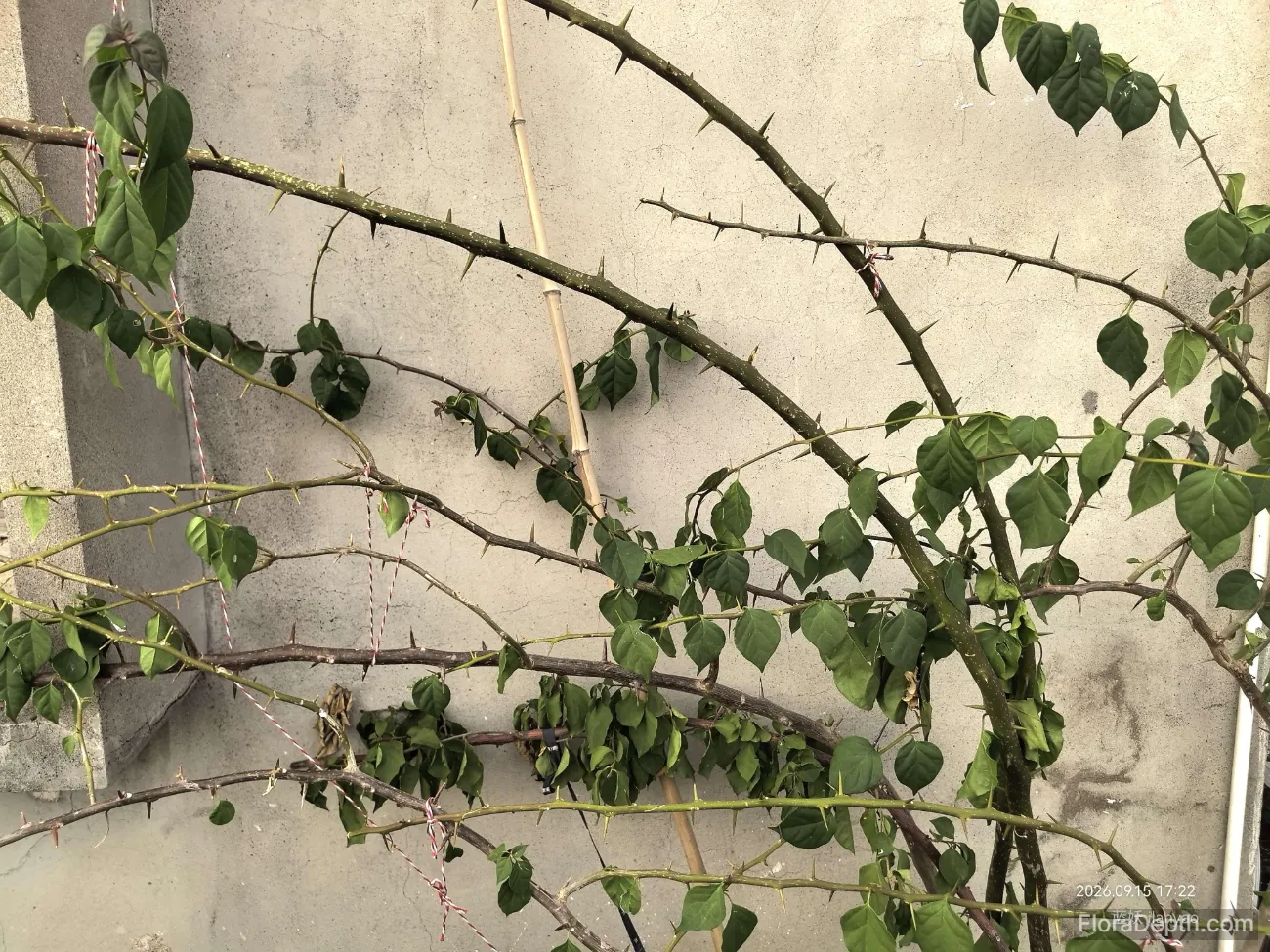
How to train bougainvillea on a trellis, fence, or grid: horizontal tying in four steps
- Choosing and positioning the support: Pick a trellis made of sturdy material and lean it against a south- or west-facing wall, ideally with 8 or more hours of sun a day. First check your USDA zone: in zones 9–11 it can climb a trellis outdoors year-round; in zone 8 and colder areas, it's best grown in a container and brought indoors before temperatures drop—below 5°C (41°F) it's prone to cold damage and leaf drop.
- Soft tying: Use soft twine or garden ties, knot them below a bud to secure the branch, and leave a finger's width of slack. Never wrap wire directly around a branch. Once the branch thickens, a dent is the least of your problems—if it cuts through, the whole branch is ruined. During the growing season, check every 6–8 weeks, loosen and re-tie.
- Horizontal guiding: During the growing season (15–30°C / 59–86°F), choose long semi-lignified branches and guide them onto the trellis horizontally or at a slight downward angle of 45–90°, arranging them in an S shape or fan pattern so the buds face up toward the sun. Don't force fully lignified old branches—they'll snap.
- Follow-up management: Once lateral buds emerge, keep the ones facing outward and upward, and pinch off the ones running inward. When side branches reach the semi-lignified stage, cut them back to 3–4 buds, and the branching will double again.
Watering and fertilizing differ by plant condition
Watering:
- Peak growing season (15–30°C / 59–86°F): water thoroughly when the soil is dry. For 2–3 weeks after branch training, keep the potting mix slightly moister—buds will emerge faster.
- Blooming period: water when dry, and don't let water sit in the pot.
- Dormant period (below 10°C / 50°F): keep it on the dry side; when the soil is completely dry, just water a circle around the edge of the pot.
Fertilizing:
- Dormant period: stop fertilizing.
- Branch-training and growth period: use a balanced nitrogen-phosphorus-potassium fertilizer to build the branches up strong first.
- Bud-forming and blooming period: switch to a high-phosphorus, high-potassium fertilizer and stop nitrogen. Too much nitrogen and you'll get leaves only, no flowers.
Reading the signals: normal vs. problems
| Symptom | Most likely cause | What to do |
|---|---|---|
| Rows of lateral buds emerge 2–3 weeks after training flat | Normal—apical dominance has been broken | Keep providing light and fertilizer |
| Lateral buds slow to sprout | Temperature below 15°C (59°F) or insufficient light | Wait for it to warm up, move to full sun |
| Leaves only, no flowers | Too much nitrogen or insufficient light | Stop nitrogen, switch to phosphorus-potassium fertilizer, ensure 8 hours of direct sun |
| Sunken, blackened spots at the tie | Tied too tightly, cutting into the bark | Untie immediately, re-tie with soft twine |
| Flowers only at the top of the trellis | Branches weren't guided horizontally | Train the lower branches horizontally and tie them down |
Note: branch training doesn't mean you can just let it go—after horizontal training, you still need to combine it with cutting back and light control. And don't dump nitrogen fertilizer on it to force buds: you'll get the buds, but you'll lose the flowers.
Bougainvillea trellis-climbing quick-reference checklist
- Check your USDA zone: zones 9–11 for outdoor trellis climbing; zone 8 and colder, grow in containers and bring indoors
- Put the trellis in a south-/west-facing spot with 8 hours of direct sun a day
- Have soft twine/garden ties ready; never wrap wire directly around branches
- During the growing season, guide and tie semi-lignified long branches horizontally or at a 45–90° angle
- Loosen and re-tie every 6–8 weeks
- Use a balanced fertilizer during branch training and growth; switch to high-phosphorus, high-potassium and stop nitrogen at bud formation
- After side branches become semi-lignified, cut back to 3–4 buds
- No heavy pruning after fall—let the branches lignify for overwintering
Common questions: how to train bougainvillea on a trellis for more blooms

Lanyao
A home flower grower with hands-on experience since 2014. FloraDepth currently focuses on practical bougainvillea care and container gardening, with more flower-growing guides to come.
More about Lanyao →Latest Garden Notes
 I have raised many roses before, and when it comes to pruning, it really makes my head grow bigger. For no oth…
 I walk past this clematis every day without really paying it any mind, but you know what? It's getting greener…
 While checking on my bougainvilleas today, I noticed one plant showing clear signs of anthracnose, with its le…
Related Articles
How to Make Bougainvillea Bloom: The Ultimate Guide
Learn how to make bougainvillea bloom with our complete care guide. Discover the exact sun, watering, fertilizer, and pruning secrets for non-stop flowers.
Bougainvillea Losing Flowers? 7 Reasons & How to Save It
Is your bougainvillea losing flowers or dropping buds? Discover 7 common causes—from overwatering to cold stress—and learn how to save your plant today!
Can Bougainvillea Bloom in Shade?
Wondering can bougainvillea bloom in shade? Discover the minimum light requirements, pruning tips for leggy growth, and a proven blackout method to force blooms in low-light yards.

How Much Sun Does Bougainvillea Need to Bloom?
Discover how much sun a bougainvillea needs to bloom. Learn the ideal 6-12 hour direct sunlight rule, avoid common traps, and force blooms today!
how often to water bougainvillea
Master the ideal watering routine for potted and garden bougainvilleas. Learn how often to water bougainvillea by season, dry-out cycle tips, and easy ways to prevent root rot or encourage vibrant blooms.